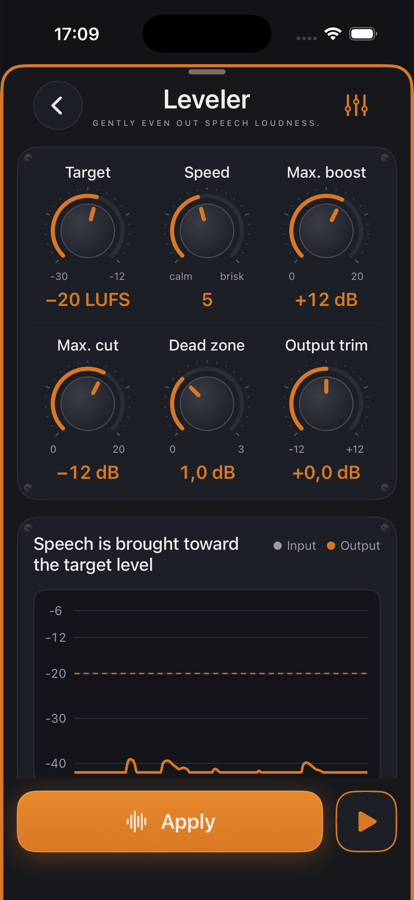
What the effect is for
A voice drifts over a recording: the speaker leans back, gets quieter, comes closer again. A compressor works too fast for that — it hears syllables, not sentences. The leveler measures loudness per ITU-R BS.1770 over seconds and follows with the gain so slowly that nothing audible happens within a word.
During pauses the gain freezes so the room noise is not pulled up. A dead zone keeps the leveler from reacting to small deviations at all.
Benefits
- ✓Even loudness across the whole episode — without a compressor's pumping.
- ✓Analysis up front: the chart shows input (grey) and output (orange) over time, plus “on target” and “frozen” figures.
- ✓Six knobs, plus an expert section for time constants and freeze.
- ✓The gain curve can be shown over the waveform in the editor.
Included for free